Welcome.

안녕하세요!
مرحبا عليكم!

I study languages.

Sunday, February 6, 2011

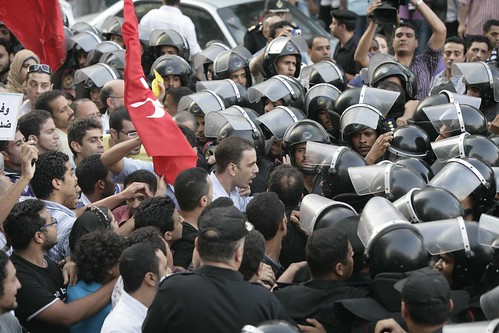
Les Mis/Cairo mashup.

Red, the blood of angry men!
Black, the dark of ages past!
Red, the world about to dawn!
Black, the night that ends at last!

Do you hear the people sing?
Singing the song of angry men
It is the music of a people who will not be slaves again
When the beating of your heart echoes the beating of the drum
There is a life about to start when tomorrow comes!

Will you join in our crusade?
Who will be strong and stand with me?
Beyond the barricade is there a world you long to see?
Then join in the fight that will give you the right to be free!

Do you hear the people sing?
Lost in the valley of the night
It is the music of a people
Who are climbing to the light
For the wretched of the earth
There is a flame that never dies
Even the darkest night will end
And the sun will rise!

Do you hear the people sing?
Say, do you hear the distant drums?
It is the future that they bring
When tomorrow comes!

Saturday, February 5, 2011

Central dogma.

Somehow the Central Dogma has proven itself at least as applicable to a linguist as it is to a molecular biologist.
Transcription (of interviews with study abroad participants, and of news broadcasts in Arabic) and translation (Arabic to English) are as central to my current career as polymerase chain reactions and restriction enzyme digests were to my career in molecular biology. 
Go figure.

Thursday, February 3, 2011

Stitched.

Every day I find myself walking along, happy and normal, and then I stop and think to myself, "Hey, the only thing keeping the left side of my abdomen from gaping wide open is a row of spindly black stitches," and I kind of freak out a little bit.

P.S. I think my scar is going to be squiggly in the middle, not straight--kind of like a lateral Harry Potter. Further developments pending. It's probably going to be with me my whole life, so I hope I like the way it turns out!

Tuesday, February 1, 2011

Art 3.

What Happens When Native Arabic Speakers Are Fortunate Enough To Run Into Me and My Egyptian Colloquial "Skills"
a story in pictures

Monday, January 31, 2011

Flowering.

"The bud stands for all things,
even for those things that don't flower,
for everything flowers, from within, of self-blessing;
though sometimes it is necessary
to reteach a thing its loveliness,
to put a hand on its brow
of the flower
and retell it in words and in touch
it is lovely
until it flowers again from within, of self-blessing..."

--from Galway Kinnell's "Saint Francis and the Sow"

Sunday, January 30, 2011

Apropos.

Today the work of Arab poet Nizar Qabbani (نزار قباني) reminds me of Wednesday's scene in Tahrir Square.
Finding this poem in its original Arabic (and subsequently retranslating it back into English myself; thanks, Hans Wehr!) took me hours. I started by attempting to back-translate the most important points of the English version I know into what I thought might be Google-able search terms in Arabic. I then attempted to use those terms to sift through huge databases (in Arabic) of the prolific poet's work to find something (in Arabic) that sounded like the poem I know in English. This particular poem also happens to be nameless, which really did not help.
 لكن معلش.
Feast on the fruits of my success!

.   .   .   .   .   .   .   .   .   .   .   .   .   .   .   .   .   .   .   .   .

We want an angry generation
We want a generation which plows the sky
To blow up history
To blow up our thoughts.
We want a new generation
That does not forgive mistakes
That does not bend.
We want a generation of giants. . .
Arab children,
Spring rain,
Corn ears of the future,
You are the generation
That will overcome defeat.

نريد جيلا غضبا
نريد جيلا يفلح الآفاق
و ينكش التاريخ من جزوره
و ينكش الفكر من الأعماق
نريد جيلا قادما مختلف الملامح
لا يغفر الأخطاء . . . لا يسامح
لا ينحني . . . لا يعرف النفاق
نريد جيلا، رائدا، عملاق
. . .
يا أيها الأطفال
يا مطر الربيع
يا سنابل الآمان
أنتم بذور الخصب في حياتنا العقيقة
وأنتم الجيل الذي سيهزم الهزيمة

Saturday, January 29, 2011

The knife.

"This is just a caricature, this, the skeleton of experience-- I mean you know this is just one slivery, wafer-thin slice. To adequately relate even five minutes of internal thought-making would take forever-- It's maddening, actually, when you sit down, as I will . . . to try to render something like this, a time or place, and ending up with only this kind of feebleness-- one, two dimensions of twenty."

"When she went in again and they had 'opened her up'--a phrase they used--and had looked inside, it was staring out at them . . . a tiny city of cancer with an unruly, sprawling, environmentally careless citizenry with no zoning laws whatsoever . . . having one single eye, one blind evil eye in the middle which stared imperiously, as only a blind eye can do, out at the doctors . . . [who] sewed her back up, leaving the city as is, the colonists to their manifest destiny, their fossil fuels, their strip malls and suburban sprawl."

--Dave Eggars, A Heartbreaking Work of Staggering Genius

I perfected my hand at surgery over the summer and today I got to experience its darker side. Despite the anesthesia I felt electrifying hysteria in my blood as my abdomen was carved like meat. The three-inch incision snakes across the bottom of my rib cage, comprising fourteen stitches, and after it heals I'll have a scar. Surgery--controlled trauma--is trauma no less.

Friday, January 28, 2011

مصر

Have you been following this?
Al-Jazeera's live stream has been playing throughout my Middle Eastern Studies classes and I cannot divert my attention. My dominant policy is to keep political science at arm's length, yet I've been talking about Hosni Mubarak and Mohamed El-Baradei all day.

More than anything, I want to yell and scream and write and know and watch and help. I want to rip things, run into the streets, and throw rocks. I want to set cars on fire, run toward guns, and make signs.

What I can't figure out is why I feel this way.

I HAVE NO TIES.
I AM NOT A MIDDLE EASTERN STUDIES MAJOR.
I AM NOT HISTORICALLY OR POLITICALLY EQUIPPED TO ANALYZE THESE TRENDS.
I AM A FLEDGLING STUDENT OF ARABIC.
I KNOW NO ONE IN EGYPT.
I HAVE NOT SPENT SUBSTANTIAL TIME IN THE COUNTRY.
I DO NOT UNDERSTAND WHY I CARE.

And yet I do, almost overwhelmingly. I don't want to do anything but watch/read/follow international (and almost totally non-American) media as Cairo burns, hoping that from its ashes will arise--what? A populist regime? A softer line from the brutal police state?

I am grateful to live in the United States of America where I can speak freely and live fearlessly under a stable and well-maintained government. I am grateful for our social, legal, economic (yes), and political infrastructure.

To succeed, this Twitter rebellion, this uprising largely organized by social media (which will shape the theses, books, and papers of my generation; I hope someone somewhere is taking screenshots) needs an ideology, a plan, and a face. Here's to staying on the edge of my seat as things play out.

God be with Egypt.
الله يبارك فيك يا مصر

Thursday, January 27, 2011

Moral imagination.

Excerpts from a speech to Stanford undergrads by William Deresiewicz.
Stuff like this makes me feel better about electing to leave my flawless med school resume for an uncertain future with the language it took years for me to admit that I liked best.

"It's not about inventing a new machine or a new drug. It's about inventing your own life. Not following a path, but making your own path. The kind of imagination I'm talking about is moral imagination. "Moral" meaning not right or wrong, but having to do with making choices. Moral imagination means the capacity to envision new ways to live your life. It means not just going with the flow. It means not just "getting into" whatever school or program comes next. It means figuring out what you want for yourself, not what your parents want, or your peers want, or your school wants, or your society wants. Originating your own values. Thinking your way toward your own definition of success. Not simply accepting the life that you've been handed. Not simply accepting the choices you've been handed. When you walk into Starbucks, you're offered a choice among a latte and a macchiato and an espresso and a few other things, but you can also make another choice. You can turn around and walk out. When you walk into college, you are offered a choice among law and medicine and investment banking and consulting and a few other things, but again, you can also do something else, something that no one has thought of before.

Moral imagination is hard, and it's hard in a completely different way than the hard things you're used to doing. And not only that, it's not enough. If you're going to invent your own life, if you're going to be truly autonomous, you also need courage: moral courage. The courage to act on your values in the face of what everyone's going to say and do to try to make you change your mind. Because they're not going to like it. Morally courageous individuals tend to make the people around them very uncomfortable. They don't fit in with everybody else's ideas about the way the world is supposed to work, and still worse, they make them feel insecure about the choices that they themselves have made—or failed to make. People don't mind being in prison as long as no one else is free. But stage a jailbreak, and everybody else freaks out.

Many students have spoken to me . . . about the pressure they felt from their peers—from their peers—to justify a creative or intellectual life. You're made to feel like you're crazy: crazy to forsake the sure thing, crazy to think it could work, crazy to imagine that you even have a right to try. Think of what we've come to. It is one of the great testaments to the intellectual—and moral, and spiritual—poverty of American society that it makes its most intelligent young people feel like they're being self-indulgent if they pursue their curiosity. You are all told that you're supposed to go to college, but you're also told that you're being "self-indulgent" if you actually want to get an education.

All you can decide is what you think now, and you need to be prepared to keep making revisions. Because let me be clear. I'm not trying to persuade you all to become writers or musicians. Being a doctor or a lawyer, a scientist or an engineer or an economist—these are all valid and admirable choices. All I'm saying is that you need to think about it, and think about it hard. All I'm asking is that you make your choices for the right reasons. All I'm urging is that you recognize and embrace your moral freedom.

And most of all, don't play it safe. Resist the seductions of the cowardly values our society has come to prize so highly: comfort, convenience, security, predictability, control. These, too, are nets. Above all, resist the fear of failure. Yes, you will make mistakes. But they will be your mistakes, not someone else's. And you will survive them, and you will know yourself better for having made them, and you will be a fuller and a stronger person."

Right now...

I'm playing statistician for my second language acquisition research and remembering how much I love manipulating/graphing/grouping/analyzing data sets (thanks, Excel!),
reading a lot of interesting Arabic thanks to المظاهرات العنفية في القاهرة,
acquiring a taste for academic linguistic papers (and acquiring the style I need to write my own),
trying out a shortened version of what once would have been my honors thesis as a political editorial,
transcribing interviews with study abroad participants and learning to put myself in their shoes,
catching up on 30 Rock (it's back!) and hanging in suspense over Dexter,
still not believing Jimmer Fredette is real (I walked by him on campus today and was way too shocked to even say congratulations!),
signing up to judge an elementary school science fair,
acing quizzes I haven't studied for (and the ones I have),
enjoying the pretty new red streak in my hair,
loving living in a spotless apartment (my roomie's mom is here),
somehow managing to be late to Biblical Hebrew every single morning (sorry, Carli!),
and trying my best to stay positive despite never finishing my neverending to-do lists.

Monday, January 24, 2011

Critique.

"It is not the critic who counts: not the man who points out how the strong man stumbles or where the doer of deeds could have done better. The credit belongs to the man who is actually in the arena, whose face is marred by dust and sweat and blood, who strives valiantly, who errs and comes up short again and again, because there is no effort without error or shortcoming, but who knows the great enthusiasms, the great devotions, who spends himself for a worthy cause; who, at the best, knows, in the end, the triumph of high achievement, and who, at the worst, if he fails, at least he fails while daring greatly, so that his place shall never be with those cold and timid souls who knew neither victory nor defeat."
--Theodore Roosevelt

"The worst sort of critics are butterfly collectors - they chase something, ostensibly out of their search for beauty, then, once they get close, they catch that beautiful something, they kill it, they stick a pin through its abdomen, dissect it and label it. The whole process, I find, is not a happy or healthy one. Someone with his or her own shit figured out, without any emotional problems or bitterness or envy, instead of killing that which he loves, will simply let the goddamn butterfly fly, and instead of capturing and killing it and sticking it in a box, will simply point to it - "Hey everyone, look at that beautiful thing" - hoping everyone else will see the beautiful thing he has seen." 
--Dave Eggars
  
I've started my second language acquisition research and as I examine the reams of data to which I now have access--numbers and words that represent months and months of gritted teeth, loneliness, tears, and Arabic--I realize I don't want to become that kind of critic. I have nothing but admiration for those who so painfully expose themselves in order to learn, who wake up and try again even when all seems lost, when progression becomes the unobtainable attestation of some naive idealist. I hope one day to count myself among them, to have other research girls transcribe my interviews and examine my journal entries, meticulously tracking my slow but steady progress and holding rulers to my results.

See?
see?
the butterfly?

Wednesday, January 19, 2011

Art 2.

me walking to school at 7 AM in Slushpocalypse 2011, of which I was regrettably unwarned. 
an artist's rendering.